Table of Contents
The Honest Answer Most Med Spas Won’t Volunteer
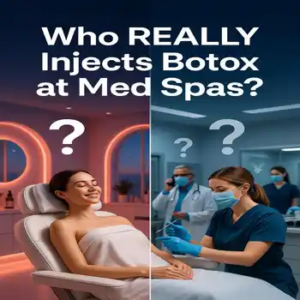
One of the most important questions a patient can ask Who performs Botox, med spa?— and one most clinics never volunteer to answer. Walk into almost any med spa in the country and ask to see the doctor, and there is a reasonable chance no doctor is in the building. That is not a scandal. It is simply how most med spas are legally structured. The person who performs Botox at a med spa is typically a registered nurse, nurse practitioner, or physician assistant operating under a supervising physician’s license. Highly trained injectors at this credential level produce outstanding, natural-looking results every day. But you are rarely told this upfront. You see the clinical décor, you hear words like “medical-grade” and “physician-supervised,” and you reasonably assume a doctor is involved in a more hands-on way than is actually the case.
This guide exists to close that information gap. Before you book a Botox appointment, you should know exactly who performs Botox at med spas, what their credentials actually mean, how supervision is supposed to work, and what questions will tell you immediately whether a clinic is operating at the standard you deserve. Knowledge is the only protection a consumer has in a largely unregulated industry — and it costs nothing to ask. If you want to compare treatment options first, see our complete guide to med spa Botox.
Why Botox Requires a Licensed Medical Provider
Botox — the brand name for botulinum toxin type A — is a prescription neurotoxin. It works by temporarily blocking nerve signals to targeted muscles, reducing the appearance of dynamic wrinkles. Because it is a prescription drug, federal law requires that it be prescribed and administered by or under the direct supervision of a licensed medical professional. This is not a technicality or a suggestion — it is a legal boundary. Any facility allowing non-licensed personnel to inject Botox is operating illegally, full stop.
The prescription classification also means that outcomes depend heavily on injector skill, anatomical knowledge, and clinical judgment — not just the drug itself. An incorrect injection site, wrong dosage, or poor technique can produce a drooping eyelid, asymmetrical expression, or in rare serious cases, complications requiring medical intervention. The license requirement exists precisely because these risks are real. That is the context behind med spa injector qualifications: the stakes are medical, even when the setting feels like a luxury spa.
Who Performs Botox at a Med Spa: Provider Types and Credentials
Authorization to inject Botox varies by state, but across the U.S. the following credential types are generally recognized as qualified to administer Botox injections — either independently or under physician oversight:
| Credential | Full Title | Supervision Required? |
|---|---|---|
| MD / DO | Medical Doctor / Doctor of Osteopathy | No — independent authority |
| NP | Nurse Practitioner | Independent in most states; collaborative agreement required in some |
| PA | Physician Assistant | Physician supervision required in most states |
| RN | Registered Nurse | Yes — requires physician order and supervision; scope varies by state |
| LPN / LVN | Licensed Practical / Vocational Nurse | Yes — permitted in select states under direct supervision only |
The critical point is that all of these credentials are legitimate. When patients ask who performs Botox at a med spa, they often expect the answer to be a physician — but many of the most skilled Botox injectors in the country hold RN or NP credentials rather than an MD. Volume, specialization, and ongoing aesthetic training matter far more than whether the letters after a name are “RN” or “MD.” What disqualifies a provider is not credential level — it is the absence of any medical license at all. You can verify any provider’s license for free through your state medical board.
Who Is NOT Authorized — and Why It Still Happens
Estheticians, cosmetologists, and medical assistants are not licensed medical providers. They cannot legally inject Botox in any U.S. state, regardless of how many weekend certificate courses they have completed. Yet it happens. Underground “Botox parties,” unlicensed practitioners working out of salons, and pop-up injection events have all been documented in enforcement actions by state medical boards and the FDA. The business models that enable this are usually built around price — dramatically lower costs that only make sense if the product is counterfeit or the injector is unqualified.
Rule of thumb: If someone offers Botox injections significantly below the local market rate — and cannot immediately name their supervising physician and medical license number — walk out. Price anomalies in injectable medicine almost always signal a compliance problem.
How the Supervising Physician Structure Actually Works
Most med spas are not physician practices. They are businesses — often owned by entrepreneurs, investors, or non-physicians — that contract with a licensed physician to serve as “medical director.” That physician signs collaborative practice agreements that give nurses and PAs the legal authority to administer treatments on behalf of the practice. This is a legal and common structure in aesthetic medicine. The quality of that arrangement, however, varies enormously from clinic to clinic.
At a well-run med spa, the medical director is physically present at least part of the week, reviews patient intake forms, participates in staff training, and is reachable immediately if a complication arises. At a poorly run one, the medical director may live in another state, have never visited the clinic, and exists primarily as a name on a compliance document. Both structures are presented to the patient as “physician-supervised.” Only one of them actually is. This distinction is not visible from the waiting room — you have to ask for it directly.
How Supervision Rules Differ by State
State law governs how close the physician must be during Botox procedures — and the variation is significant. In states with full practice authority for nurse practitioners (including Arizona, Colorado, Oregon, and Washington), an NP can prescribe and inject Botox with no physician involvement whatsoever. In reduced or restricted practice states, a collaborative agreement or on-site physician is required. RN scope of practice rules vary even more sharply: some states require the physician to be physically present in the facility during the injection; others allow telephone or telehealth availability to satisfy the supervision requirement.
This matters to you as a patient because a med spa’s legal compliance in one state does not mean the same structure would be compliant in another — and because “physician-supervised” means genuinely different things depending on where you live. Before your appointment, look up your state’s medical board regulations for nurse injectors. A five-minute search can tell you whether the supervision model a clinic describes to you meets your state’s legal standard or falls short of it.
Med Spa Injector Qualifications: Beyond the License
A valid license tells you the injector cleared the minimum legal bar for who performs Botox at a med spa. It says nothing about how many patients they have treated, whether they specialize in facial aesthetics, or whether they have invested in ongoing education beyond their base degree. Med spa injector qualifications go well beyond the license — and in an industry where technique and anatomical precision determine outcomes, the license is where your research starts, not where it ends.
The best Botox injectors at med spas typically share several characteristics beyond their core credential: they have completed structured aesthetic training through programs like the American Academy of Facial Esthetics (AAFE), the International Association for Physicians in Aesthetic Medicine (IAPAM), or manufacturer-certified programs through Allergan Aesthetics. They perform injections at high volume — meaning aesthetics is their primary practice, not a side service they offer once a week. They can show you before-and-after photographs from their own patient panel, not curated stock imagery from a brand. And they approach your consultation as a clinical conversation, asking about your facial anatomy, medical history, and goals — not rushing you to a booking.
Questions to Ask Before You Book
Most patients never ask a single question about med spa injector qualifications before their first Botox appointment. That is understandable — med spas are designed to feel trustworthy, and asking feels awkward. But a reputable clinic will welcome these questions without hesitation. The right questions immediately reveal who performs Botox at a med spa and whether their qualifications meet the standard you deserve. Any resistance, deflection, or vague non-answer is itself diagnostic information.
- “What is your injector’s credential — RN, NP, PA, or MD?” A direct question deserves a direct answer.
- “Who is your supervising or medical director physician, and will they be on-site during my appointment?” Note whether the name is given readily or hedged.
- “How many Botox treatments does your injector perform each month?” Volume is a proxy for expertise. Fewer than 20–30 per month warrants follow-up.
- “Has your injector completed additional aesthetic training beyond their nursing or medical degree?” Look for named programs, not vague claims of “extensive training.”
- “Can I see before-and-after photos from this injector’s own patients?” Not website photos — actual clinical results from the person treating you.
- “What is your protocol if I experience a complication after leaving the clinic?” A confident, specific answer here signals a well-run operation.
Red Flags to Walk Away From
Not every red flag is obvious. Some of the most problematic med spas in the country look polished and professional on the surface. These are the warning signs that should override good décor and persuasive marketing:
- Staff cannot or will not name the supervising physician
- Pricing is dramatically below local market rate with no clear explanation
- Consultation is rushed, skips your medical history, or feels like a sales pitch
- Before-and-after photos are stock images or pulled from a brand’s website
- The injector’s credential is vague (“our specialist,” “our aesthetics expert”) without a specific license type
- No written consent form is offered before treatment
- The clinic cannot describe a clear protocol for post-treatment complications
- High-pressure upselling before or during your consultation
How to Verify Credentials Yourself — For Free
Every U.S. state publishes a free, publicly searchable license verification tool through its medical or nursing board. These databases confirm whether a provider’s license is active, what their credential type is, and whether any disciplinary actions have been taken against them. To verify who performs Botox at a med spa before you book: search “[your state] nursing board license lookup” or “[your state] medical board license verification.” Enter the provider’s name or license number. The result takes under two minutes and is definitive. Do the same for the supervising physician. Understanding med spa injector qualifications before your appointment — not after — is the single most effective consumer protection available to you.
Want to know who performs Botox at the med spas in our network? We connect patients with licensed, credentialed injectors — no guesswork, no pressure.Check Provider Qualifications
FAQ-Who performs Botox, med spa
Who performs Botox injections at a med spa?
At most med spas, Botox is injected by a registered nurse (RN), nurse practitioner (NP), or physician assistant (PA) operating under a supervising physician’s license. In some clinics, the physician performs injections directly. Estheticians, cosmetologists, and medical assistants are not legally authorized to inject Botox in any U.S. state.
Is it safe to get Botox from a nurse at a med spa?
Yes — a nurse practitioner or experienced registered nurse with advanced aesthetic training can deliver excellent Botox results. The credential level (RN vs. MD) matters far less than the injector’s volume of aesthetic experience, specialized training, and the quality of physician oversight at the clinic.
What qualifications should a Botox injector have?
At minimum, a valid medical license (MD, DO, NP, PA, or RN) in the state where they practice. Beyond that, look for completion of a structured injectable training program such as AAFE or Allergan Aesthetics certification, a high monthly volume of Botox treatments, and verifiable before-and-after results from their own patients.
Do med spas always have a doctor on site during Botox injections?
No. Many med spas operate under a physician’s medical directorship without requiring the physician to be physically present during procedures. State law determines the required level of proximity — some states mandate on-site presence; others allow phone or telehealth availability. Always ask directly whether the supervising physician will be in the building during your appointment.So ask who performs Botox, med spa?
Can an esthetician legally inject Botox?
No. Estheticians are not licensed medical providers and cannot legally administer Botox injections in any U.S. state. Any facility that allows estheticians to perform injectable treatments is operating outside the law. State medical boards actively investigate and shut down these operations.
How do I verify a Botox injector’s credentials before my appointment?
Search your state’s nursing or medical board license lookup tool — all are free and publicly accessible. Enter the provider’s name or license number to confirm their license type, active status, and any disciplinary history. Do the same for the supervising physician. This verification takes under two minutes and confirms you are starting from a legally compliant baseline.
What is a medical director at a med spa?
A medical director is a licensed physician who signs a collaborative practice or supervisory agreement with a med spa, giving nurses and physician assistants the legal authority to administer treatments under the practice’s medical license. The quality of this arrangement varies significantly — from physicians who are actively involved in patient care to those whose involvement is primarily administrative.
Useful links: who performs Botox med spa ->, med spa injector qualifications ->