
Table of Contents
When you schedule a filler appointment at a med spa, you expect skilled hands and safe results. But who actually performs your injections? The answer varies widely. Some med spas staff physicians. Others rely on nurse injectors. Understanding the difference between a nurse injector vs physician helps you make confident decisions about your care.
This guide breaks down med spa provider qualifications, training paths, legal requirements, and what actually matters when choosing your injector.
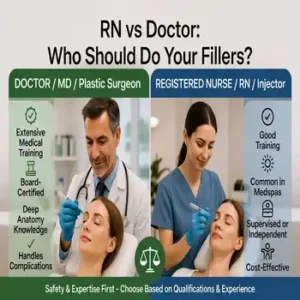
The Providers Behind Your Filler Treatment
Walk into any reputable med spa and you may encounter several types of providers. Each brings different training, experience, and credentials to the treatment room.
Physicians (MD/DO)
Medical doctors and doctors of osteopathy complete four years of medical school plus residency training. Some specialize in dermatology or plastic surgery, spending years focused on aesthetic procedures. Others come from family medicine, emergency medicine, or other fields and add aesthetic training later.
A physician’s medical education covers anatomy, physiology, pharmacology, and patient safety at the deepest level. When complications arise, physicians have broad diagnostic and treatment authority.
Nurse Practitioners (NP)
Nurse practitioners hold advanced nursing degrees and can practice independently in many states. Their training includes clinical rotations and hundreds of supervised patient hours. Many NPs pursue specialized aesthetic certifications after completing their primary education.
In the nurse injector vs physician comparison, NPs often bridge the gap. They combine nursing’s patient-centered approach with advanced medical training.
Registered Nurses (RN)
Registered nurses complete nursing programs and pass national licensing exams. In most states, RNs can perform injections under physician supervision. The supervising physician must be available for consultation, though not necessarily on-site.
Many experienced RN injectors develop exceptional skills through years of focused practice. Their med spa provider qualifications include specialized training programs, manufacturer certifications, and continuing education.
Physician Assistants (PA)
Physician assistants complete graduate-level medical training and practice under physician supervision. Like NPs, they can assess patients, develop treatment plans, and perform procedures including injectable treatments.
Training and Certification: What the Credentials Mean
Med spa provider qualifications extend beyond basic licenses. The best injectors pursue ongoing education throughout their careers.
Medical Degree vs. Nursing Degree
A physician’s path includes:
- Four-year undergraduate degree
- Four years of medical school
- Three to seven years of residency
- Optional fellowship for subspecialty training
A registered nurse’s path includes:
- Two to four years of nursing education
- National licensing examination (NCLEX-RN)
- State licensure requirements
Neither path automatically includes aesthetic injection training. Both physicians and nurses must seek additional education to master filler techniques.
Aesthetic-Specific Training
The most qualified injectors—regardless of their base credential—complete:
Manufacturer Training Programs: Allergan, Galderma, and other filler makers offer certification courses. These cover product-specific techniques, facial anatomy, and complication management.
Hands-On Workshops: Cadaver labs and live patient training sessions build practical skills that textbooks cannot teach.
Advanced Anatomy Courses: Understanding facial vasculature, nerve pathways, and tissue planes prevents complications. Top injectors study anatomy continuously.
Continuing Education: Medicine evolves. New products, techniques, and safety protocols emerge regularly. Committed providers stay current through conferences, courses, and peer learning.
When evaluating med spa provider qualifications, ask about this additional training. A physician without aesthetic experience may be less qualified than a nurse injector with five years of focused filler work.
Legal Requirements: State by State Differences
The nurse injector vs physician debate plays out differently depending on where you live.
Supervision Requirements
Some states require physicians to be physically present when nurses perform injections. Others allow remote supervision via telemedicine. A few permit experienced NPs to practice independently without physician oversight.
Before your appointment, understand your state’s rules. Ask the med spa about their supervision protocols. Legitimate practices explain their compliance openly.
Scope of Practice Laws
Each state defines which procedures different providers can perform. Some restrict certain injection techniques to physicians only. Others allow any properly trained provider to perform the same treatments.
These laws shape how med spas staff their practices. A med spa in one state might employ only physicians for injections. The same company’s location across state lines might use nurse injectors extensively.
What This Means for Your Safety
Legal compliance matters, but it tells only part of the story. A provider can meet every legal requirement while still lacking the skill you deserve. Conversely, strict supervision rules do not guarantee superior outcomes.
Focus on individual qualifications, experience, and results rather than credentials alone.
Skill Matters More Than Title
Here is what experienced aesthetic patients learn: the individual injector matters more than their degree.
The Experience Factor
A registered nurse who performs 50 filler treatments monthly develops pattern recognition, muscle memory, and problem-solving instincts. A physician who does five treatments monthly—while managing a busy primary care practice—may not build the same specialized expertise.
Volume matters. Ask potential injectors how many filler treatments they perform each month. Ask how long they have focused on aesthetics specifically.
Artistic Eye and Technical Precision
Fillers require both science and art. The injector must understand facial anatomy to avoid complications. They must also see facial proportions, balance, and beauty to create natural results.
Some providers have this combination naturally. Others develop it through deliberate practice and mentorship. Degrees do not guarantee aesthetic vision.
Complication Management
When problems occur, response speed and competence determine outcomes. Vascular occlusion—when filler blocks a blood vessel—requires immediate recognition and action. Every second counts.
Ask prospective injectors about their complication training. Do they stock hyaluronidase to dissolve filler emergencies? Have they managed serious adverse events? Their answers reveal their preparedness.
Questions to Ask Before Your Filler Appointment
Evaluating med spa provider qualifications requires direct conversation. Bring these questions to your consultation:
About Training and Experience
- How many years have you performed filler injections?
- How many filler treatments do you perform monthly?
- What manufacturer certifications do you hold?
- What advanced training have you completed in the past year?
- Do you specialize in certain facial areas or filler types?
About Safety Protocols
- What is your complication rate?
- How do you handle vascular occlusion?
- Is a physician available on-site or by phone during my appointment?
- What emergency equipment and medications do you keep on hand?
About Results
- Can I see before-and-after photos of your actual patients?
- What results are realistic for my concerns?
- How do you approach natural-looking enhancement?
The right provider welcomes these questions. Evasive answers signal problems.
The Nurse Injector vs Physician Decision: A Framework
Rather than choosing based on title alone, evaluate providers on these factors:
Choose Based on Your Specific Needs
For complex cases involving facial asymmetry, prior complications, or medical conditions, a physician’s broader diagnostic training may matter more.
For straightforward enhancement like lip filler or smile line correction, an experienced nurse injector often delivers excellent results.
For revision work correcting another provider’s outcomes, seek someone with extensive experience in your specific concern—regardless of their credential.
Red Flags to Avoid
Watch for these warning signs regardless of provider type:
- Unwillingness to answer questions about training
- No before-and-after photos available
- Pressure to decide quickly or book immediately
- Prices dramatically below market rates
- Unclear supervision or licensing arrangements
- Spaces that look unclean or disorganized
Green Flags to Seek
Positive signs include:
- Transparent discussion of qualifications and experience
- Extensive before-and-after galleries showing consistent results
- Thorough consultation before any recommendations
- Clear explanations of risks, alternatives, and realistic outcomes
- Professional, clean environment
- Easy access to physician consultation when needed
What Board Certification Means
You may see providers advertise “board certification.” This term requires context.
Physician Board Certification
For doctors, board certification means passing rigorous exams in a medical specialty. Relevant boards for aesthetic medicine include:
- American Board of Dermatology
- American Board of Plastic Surgery
- American Board of Facial Plastic and Reconstructive Surgery
These certifications require years of specialized training and ongoing recertification.
Nursing Certifications
Nurses can earn certifications through organizations like:
- Plastic Surgical Nursing Certification Board
- American Academy of Aesthetic Medicine
- Various manufacturer-specific programs
These demonstrate commitment to aesthetic nursing but differ from physician board certification in scope and requirements.
Evaluating Certifications
Ask specifically which boards or organizations granted the certification. Research what the certification requires. Not all credentials carry equal weight.
Making Your Decision With Confidence
The nurse injector vs physician choice ultimately depends on the individual provider, not the degree.
A highly trained, experienced nurse injector working in a physician-supervised practice may deliver better outcomes than an inexperienced physician. Conversely, a physician who focuses exclusively on aesthetics brings depth of training that matters.
Your job is to evaluate the specific person who will hold the syringe.
Steps to Find Your Ideal Injector
- Research med spa provider qualifications for practices in your area
- Read reviews focusing on comments about specific providers
- Schedule consultations with your top two or three choices
- Ask direct questions about training, experience, and results
- Review before-and-after photos of actual patients
- Trust your instincts about the provider’s competence and communication
The right injector makes you feel informed, respected, and confident. They answer questions without defensiveness. They set realistic expectations rather than overpromising.
Book Your Free Consultation
Choosing between providers feels overwhelming until you meet them in person. A consultation reveals what credentials cannot: how the injector communicates, whether they understand your goals, and if you trust their judgment.
Our med spa team includes qualified providers with extensive aesthetic training. During your consultation, we discuss your concerns, explain options, and answer every question about our qualifications and approach.
Book Your Free Consultation today. Meet our team, review their credentials, and decide if we are the right fit for your filler appointment.
FAQ-Med Spa provider qualifications
Is it better to get fillers from a doctor or nurse?
The best injector is whoever has the most relevant training, experience, and demonstrated results—regardless of their base degree. An experienced nurse injector often outperforms an inexperienced physician for routine filler appointments. Evaluate individuals, not titles.
What qualifications should a filler injector have?
Strong med spa provider qualifications include: appropriate state licensure, manufacturer certifications for the products used, advanced anatomy training, documented experience with your specific concern, and complication management training. Ask for specifics during your consultation.
Can registered nurses legally perform filler injections?
In most states, registered nurses can perform filler injections under physician supervision. Supervision requirements vary by state—some require on-site physicians while others allow remote oversight. Verify your state’s requirements and ask how the med spa maintains compliance.
How do I verify a med spa provider’s qualifications?
Check state licensing boards to confirm active licenses. Ask the provider directly about their training, certifications, and experience level. Request before-and-after photos of their work. Research any board certifications they claim through the certifying organization’s website.
What is the difference between nurse injector vs physician training?
Physicians complete medical school plus residency, providing deep medical knowledge. Nurses complete nursing programs focused on patient care. Neither automatically includes aesthetic injection training—both must pursue additional education. The difference in aesthetic outcomes depends more on specialized training and experience than the base degree.
Should I choose a board-certified plastic surgeon for fillers?
Board-certified plastic surgeons have extensive training relevant to facial aesthetics. However, they may focus primarily on surgical procedures rather than injectables. A nurse injector who performs fillers daily may have more current, hands-on experience than a surgeon who does occasional injectable work between surgeries.
How many fillers should my injector have performed?
Look for providers who perform filler appointments regularly—ideally multiple times weekly. Ask how long they have specialized in aesthetics and approximately how many filler sessions they complete monthly. Experience builds judgment that training alone cannot replace.
What questions should I ask about med spa provider qualifications?
Ask about years of aesthetic experience, monthly volume, specific training completed, manufacturer certifications held, complication management protocols, and supervision arrangements. Request before-and-after photos. A qualified provider answers these questions confidently and completely.
Ready to find the right injector for your fillers? Book Your Free Consultation and meet our qualified team.
Our social media ->