
Table of Contents
Your provider tells you Botox side effects med spa are minimal. That’s mostly true. But “minimal” doesn’t mean none — and there’s a short list of effects that are common, expected, and temporary, alongside a much shorter list that are rare but worth knowing about before you sit down. Here’s what the fine print actually says.
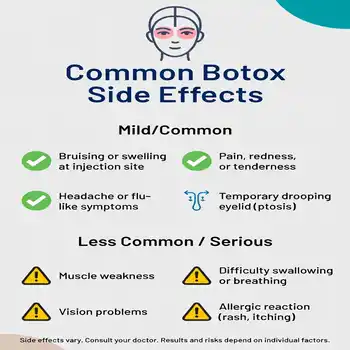
Common Botox Side Effects — Normal and Expected
Redness and Swelling at Injection Sites
Small red dots or minor swelling at each injection point is completely normal and resolves within 20–30 minutes for most patients. Some mild puffiness can persist for a few hours. This is not an allergic reaction — it’s a standard response to the needle and will resolve on its own.
Bruising
Bruising occurs in roughly 10–25% of Botox patients depending on the treatment area and individual factors. It’s more common in patients who take blood thinners or supplements like fish oil, those who bruise easily in general, and in higher-risk areas like under the eyes or around the lips. Bruising typically resolves in 5–7 days and can be covered with makeup after 24 hours. See our Botox prep checklist for how to minimize bruising risk before your appointment.
Headache
A mild headache in the hours following forehead Botox is reported by a subset of patients — particularly first-timers. It typically resolves within 24 hours and responds to standard over-the-counter pain relief (acetaminophen, not ibuprofen in the first 24 hours post-treatment). If headaches persist beyond 48 hours, contact your provider.
Heaviness or Pressure Sensation
Some patients describe a feeling of heaviness or tightness in the treated area, particularly the forehead, as the Botox takes effect over the first week. This is the muscle relaxation process and typically fades as the body adjusts to the reduced movement. It’s not a sign something went wrong.
Less Common Side Effects Worth Knowing
Eyelid Drooping (Ptosis)
The most commonly cited serious side effect — and the one that generates the most fear before a first appointment. Ptosis occurs when Botox migrates to the muscle that holds the eyelid open. It results in a drooping appearance in one or both eyelids. It is temporary — resolving as the Botox wears off over weeks — and it is rare when treatment is performed by an experienced injector using correct placement and dosing. The risk is higher with inexperienced injectors and increases if you rub the treated area aggressively in the hours after treatment. This is one of the core reasons provider selection matters. See our guide on who really performs Botox at med spas.
Asymmetry
Botox doesn’t always take effect equally on both sides — facial muscle asymmetry is more common than most people realize, and Botox can highlight differences that were already present. Minor asymmetry is common after a first treatment and often corrects itself or is addressed with a small touch-up at the two-week follow-up. Significant asymmetry that persists past two weeks warrants a provider conversation.
Ask Every Question Before You Book
A free consultation is where you get honest, specific answers about your side effect risk based on your anatomy and treatment area — before any needles.
What to Do If You Experience a Side Effect
- Bruising or swelling: Ice the area gently (no direct pressure), avoid blood thinners, and wait. Arnica gel can speed resolution.
- Headache: Acetaminophen, rest, hydration. If it persists past 48 hours, contact your provider.
- Eyelid drooping: Contact your provider immediately. Prescription eye drops (apraclonidine) can temporarily lift the lid while the Botox wears off. Do not wait it out without telling someone.
- Asymmetry at 14 days: Schedule a touch-up conversation. Do not wait past two weeks hoping it will self-correct — the treatment window for touch-ups is limited.
Treat With a Provider Who Tells You the Truth
Side effects are real. Most are minor and temporary. A qualified provider explains all of them before treatment — and has a clear policy for handling the ones that need follow-up.
FAQ – Botox Side Effects Med Spa
What are the most common Botox side effects?
Redness and minor swelling at injection sites, bruising, mild headache, and a temporary heaviness or pressure sensation in the treated area. All are temporary and resolve within days to two weeks.
Can Botox cause eyelid drooping?
Yes, but it is rare with an experienced injector. Ptosis occurs when product migrates to the muscle that holds the eyelid open. It is temporary — resolving as the Botox wears off — and treatable with prescription eye drops in the interim. Risk increases significantly with inexperienced injectors.
How long do Botox side effects last?
Most common side effects (redness, swelling, bruising) resolve within 5–7 days. Headache typically clears within 24–48 hours. Eyelid drooping, if it occurs, resolves over several weeks as the Botox metabolizes.
Is it normal to feel nothing after Botox?
For the first 1–3 days, yes. Botox takes time to establish its effect at the neuromuscular junction. Visible results typically appear between days 3 and 7, with full effect by day 14. Zero visible change at day 14 is not normal and warrants a provider conversation.