Why “Botox Near Me” Searches Are a Safety Gamble
Everyone types “Botox near me safe” into Google at some point. It feels like the right first move — find something local, read a few reviews, book an appointment. But here’s what that search doesn’t tell you: proximity has nothing to do with safety. Local Botox safety is not guaranteed by a facility being close to your zip code. There are med spas operating within three miles of your house that have no business putting a needle near your face. Before you book the first result that shows up, you need to understand what makes a Botox provider legitimate — and what the med spa Botox risks are when you skip that evaluation entirely.
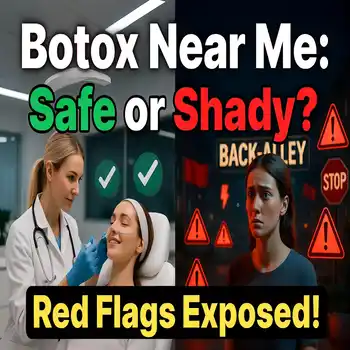
Table of Contents
The Local Botox Safety Standard Nobody Talks About
Local Botox safety starts with one question: who is holding the needle? Botox is botulinum toxin — a neurotoxin that temporarily paralyzes targeted facial muscles to reduce the appearance of wrinkles. When administered correctly by a trained, licensed medical professional, it is one of the safest cosmetic procedures available. When it is not, the list of things that can go wrong is long. Drooping eyelids, asymmetrical results, bruising, headaches, and in rare cases difficulty swallowing are all documented med spa Botox risks that result not from the product itself but from improper injection technique or dosing. The neurotoxin doesn’t become dangerous on its own — the provider does.
To properly vet any provider before your appointment, you need to verify three things: the medical director’s license, the injector’s credential and experience level, and the product source. A facility with a board-certified physician medical director, a credentialed RN or NP injector with documented injectable training, and Botox sourced directly from Allergan’s licensed distribution network is a facility where Botox near me safe is a realistic expectation rather than a lucky outcome.
8 Red Flags That Expose a Shady Botox Provider
The following red flags apply whether you found a provider through a “Botox near me safe” search, a social media ad, or a friend’s recommendation. They are non-negotiable disqualifiers. A reputable provider will not have any of them. If you spot even one, move on before you schedule anything.
Red Flag 1 — No Medical Director Named. Every licensed med spa must operate under physician oversight. If the facility cannot name their medical director and provide that physician’s license number on request, they may not have one — and that is both a legal violation and one of the most serious med spa Botox risks you can encounter. Without a supervising physician, there is no accountability structure, no emergency protocol, and no one legally responsible for your outcome. Red Flag 2 — Suspiciously Low Pricing. Botox is priced by the unit, and the cost of the product itself has a floor. If a provider is offering Botox at $6 per unit or less, something is wrong. Either the product is diluted, counterfeit, or the injector has no experience and is competing on price because they cannot compete on results. Cheap Botox is one of the most reliable indicators of elevated med spa Botox risks.
Red Flag 3 — Injections in Non-Clinical Settings. Botox administered in a hotel room, at a “Botox party,” or in any space that is not a licensed clinical facility is a local Botox safety failure at every level. There is no emergency equipment, no sterile environment, no sharps disposal, and no accountability. The setting is not a technicality — it is a core safety requirement. Red Flag 4 — No Intake Form or Medical History Review. Before any Botox injection, a provider should collect your full medical history — current medications, prior injectable history, and known allergies. Certain medications (blood thinners, muscle relaxants) interact with Botox. Certain conditions (neuromuscular disorders, pregnancy) contraindicate it entirely. Skipping this process is not efficiency — it is negligence, and a direct cause of preventable med spa Botox risks.
Red Flag 5 — Inability to Name the Product Brand. Any legitimate injector can tell you exactly which product they are using and why. If the answer to “what are you injecting me with?” is vague or evasive, that is a problem. Counterfeit botulinum toxin — illegally imported and not FDA-approved — is a documented risk in the U.S. market, and verifying the product is a non-negotiable step before you allow anything to be injected. Red Flag 6 — No Informed Consent Document. Before treatment you should sign a consent form explaining the procedure, the product being used, potential risks and side effects, and your right to decline. A provider who skips consent is not protecting you — they are protecting themselves from having to disclose what they are about to do.
Red Flag 7 — High-Pressure Sales During Consultation. A legitimate Botox consultation is a clinical conversation. If it feels like a retail pitch — with upsells, urgency tactics, and bundled packages pushed before you have decided to do anything — the business model is revenue-first, safety second. This environment pressures you to proceed before you are ready — a dynamic that consistently leads to poor outcomes. Red Flag 8 — No Aftercare Instructions. After Botox, specific aftercare is required: avoid lying down for four hours, skip intense exercise for 24 hours, do not rub the injection sites. A provider who does not give you clear written aftercare instructions does not have the operational standard to be giving you injections in the first place.
What “Botox Near Me Safe” Actually Looks Like
When you search Botox near me safe and find a result worth booking, it will have several verifiable characteristics. The website names the medical director and lists provider credentials. The practice has been operating for at least two to three years with a consistent provider team — not a rotating staff of contractors. Reviews mention specific providers by name, describe realistic results, and include mentions of thorough consultations. The booking process includes pre-appointment health forms. The facility looks and operates like a medical practice, not a beauty salon with an injectable add-on.
Making a Botox near me safe search productive means going beyond the first page of results and beyond star ratings. The best local Botox safety verification is talking to the provider directly: call the practice, ask who the medical director is, ask what product they use and where they source it, and ask how many Botox procedures the injector performs per week. A competent, confident practice will answer every one of those questions without hesitation. A practice that hedges, redirects, or gets defensive is telling you something important.
Med Spa Botox Risks: The Full Clinical Picture
Understanding med spa Botox risks means separating the risks that exist in any clinical setting from the risks that exist specifically because of poor provider quality. Botox administered by a competent, licensed injector in a properly equipped med spa has a well-documented safety profile. The most common side effects are mild and temporary: bruising at the injection site (typically resolves in five to seven days), mild headache (usually within the first 24 hours), and slight swelling. These are expected clinical responses that an experienced injector will discuss with you before the procedure — not surprises.
The med spa Botox risks that arise from substandard care are a different category. Eyelid ptosis — drooping of one or both eyelids — occurs when Botox migrates from the injection site due to improper technique. It can last weeks to months and is almost entirely preventable with proper placement. Asymmetrical results and a frozen, expressionless forehead are consequences of technique errors, not the product itself. These outcomes are predictable consequences of choosing a provider without the training to deliver consistent results. Local Botox safety evaluation exists to filter out those providers before they become your cautionary tale.
The most serious med spa Botox risks involve counterfeit or improperly handled product. Botulinum toxin must be stored at specific temperatures and used within a defined window after reconstitution. Product that has been improperly stored or sourced outside FDA-approved channels introduces variables no injector skill can compensate for. Counterfeit Botox cases — including hospitalizations — have been documented by the CDC. When local Botox safety auditing includes asking where the product comes from, this is exactly the risk you are defending against.
How to Verify a Botox Provider Before You Book
Making sure Botox near me safe is achievable takes less than 15 minutes. Step one: look up the medical director’s license on your state’s medical licensing board — it is a public record search. If the name they provide doesn’t pull an active license, stop there. Step two: search the injector’s name plus their license type (RN, NP, PA) on the state board. Verify the license is active and unrestricted. Step three: call the practice and ask where they source their Botox. The answer should name an FDA-approved manufacturer — Allergan, Galderma, Merz, or Evolus — and a licensed U.S. distributor.
Step four: ask how many Botox procedures the injector performs per week. Fewer than ten per week means they are gaining experience at your expense. Step five: book a consultation before committing to treatment. Your in-person impression of the facility and the provider’s communication style are equally part of the evaluation. If the consultation is rushed, if the injector doesn’t study your face before making recommendations, or if you feel like a number rather than a patient — trust that. A provider who gives you a thorough, unhurried consultation is demonstrating exactly the standard of care they will bring to the procedure itself.
What a Safe Botox Consultation Must Include
A legitimate Botox consultation — the kind that makes Botox near me safe something you can say with real confidence — follows a specific clinical structure. The provider starts with your medical history: current medications, supplements that increase bruising risk (fish oil, vitamin E, aspirin), previous injectable treatments, any history of adverse reactions, and relevant health conditions. They then assess your facial anatomy — muscle mass, skin laxity, symmetry, and movement patterns — while you make facial expressions. They explain exactly what product they are recommending, why, how many units, and what results are realistic for your specific face. They set the expectation that Botox takes three to seven days to take full effect and that a two-week follow-up may be needed for minor corrections.
The consultation also covers the specific risks relevant to your anatomy and treatment plan. A good injector does not hide the risk list — they review it so your consent is genuinely informed. They explain the difference between expected side effects (mild bruising, slight swelling) and outcomes worth calling about (asymmetry persisting beyond two weeks, eyelid drooping, difficulty swallowing). They give you a direct line to reach them if you have post-treatment concerns. When a provider skips any of these steps, they are not being efficient — they are showing you how they will handle problems when they arise.
State Regulations That Shape Local Botox Safety
State law shapes what is and isn’t legally permissible at any given provider, and regulations vary significantly across the U.S. In some states, only physicians and nurse practitioners can perform Botox injections. In others, registered nurses and physician assistants can inject under physician supervision. In a smaller number of states, the regulatory gap is wide enough that providers with minimal medical training can legally administer injectables. Knowing your state’s rules tells you what to expect and what questions to ask when a provider’s credentials seem unusual. It also tells you when a credential that sounds legitimate falls below the standard your state should require.
What Safe Botox Actually Costs in 2026
Price is one of the most reliable proxy indicators of Botox near me safe quality. In 2026, Botox is typically priced between $12 and $18 per unit at a reputable med spa in most U.S. markets. A standard forehead treatment uses 10 to 30 units depending on the area and muscle mass. Total treatment cost for two to three areas typically ranges from $400 to $900. When pricing is significantly below this range — $8 per unit, $99 full-face specials — the discount has to come from somewhere. It comes from the product, the provider, or the facility standards. None of those are places where you want corners cut.
The cheapest Botox near me safe option is not the lowest price in your search results. It is the lowest price among providers who have passed all of the verification steps above. Within that filtered set, it is reasonable to compare pricing and ask about packages or loyalty programs for returning patients. Chasing the lowest advertised price without doing credential verification first is how people end up with complications they did not expect and a provider who is not equipped to manage them.
Frequently Asked Questions
How do I know if a Botox provider near me is safe? A provider worth booking will clearly name their medical director, state the injector’s license type and experience volume, and tell you exactly what product they use and where it’s sourced — all before you’ve booked anything. If any of those answers are evasive, that’s your answer.
What are the most serious med spa Botox risks? The most clinically significant are eyelid ptosis from improper injection placement, significant facial asymmetry from uneven dosing, and adverse reactions from counterfeit or improperly stored product. All three are driven by provider quality and sourcing standards — not by the procedure itself.
Is Botox at a med spa as safe as at a dermatologist? Safety is determined by the provider’s training, the product quality, and facility standards — not by whether the setting is labeled a med spa or a dermatologist’s office. A highly trained nurse practitioner at a well-run med spa can deliver safer results than a poorly trained physician in an under-equipped office. Verification of credentials and protocols matters more than the type of setting.
What should local Botox safety verification include? License checks for both the medical director and the injector, product source confirmation, in-person facility assessment during your consultation, and a direct evaluation of how thorough and unhurried the consultation itself felt. Those are your five data points.
The Bottom Line
Local Botox safety is an achievable standard — but only if you do the work to verify it before you book. The red flags in this post describe real practices operating in real local markets that patients are walking into right now without knowing what to look for. The industry does not enforce a universal consumer-protection standard that does the work for you. The good news: the verification process is simple, fast, and fully within your control. Name the medical director. Check the injector’s license. Confirm the product source. Walk through the consultation. If everything checks out, you have found a provider worth booking. If anything doesn’t, you have just avoided a problem that would have been far more expensive to fix than the treatment itself.
Ready to find a med spa that meets every standard? Visit medspas.website to connect with vetted, medically supervised providers in your area — evaluated for provider credentials, product sourcing, and clinical protocols so your search ends with confidence, not guesswork.
Useful links: post ->