
If you’ve ever moved to a new city and noticed that the med spa landscape felt completely different — more options, different price points, different vibes — you weren’t imagining it. Med spa regulations vary dramatically from state to state, and where you live determines how much protection you actually have as a patient.
In some states, a physician must own the facility and be on-site for every procedure. In others, a non-physician can own and operate a med spa as long as they have a licensed provider performing treatments. In a few states, the oversight is so loose that enforcement is essentially complaint-driven — meaning no one checks until something goes wrong. So see Med Spa Regulations by State.
This guide breaks down the regulatory landscape state by state, explains what “medical director” actually means (versus what it’s claimed to mean), and tells you exactly how to protect yourself regardless of where you live.
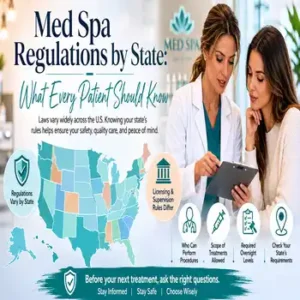
Table of Contents
Why Med Spa Regulations Vary So Much
Healthcare regulation in the United States is primarily a state function, not a federal one. The FDA oversees the products used — Botox, Dysport, dermal fillers — but the practice of medicine, including who can perform procedures and under what supervision, is governed by each state’s medical board, nursing board, and department of health.
Med spas emerged as a category before most states had specific regulations for them. That created a patchwork: some states adapted their existing medical practice laws to cover med spas explicitly; others apply general medical practice rules that weren’t designed with aesthetics in mind; and a few haven’t meaningfully addressed the sector at all.
The result is that two med spas offering identical services — one in Texas, one in California — may be operating under entirely different legal frameworks.
What “Medical Director” Actually Means
Nearly every state requires med spas to have a physician medical director. But the requirement varies enormously in what it actually demands of that physician.
In the strictest states: The medical director must be on-site or immediately available when procedures are performed. They must review treatment plans, be reachable for complications, and maintain active clinical involvement in the practice.
In most states: The medical director must have a valid license and sign off on protocols and standing orders. They’re often not required to be physically present for individual treatments.
In the loosest interpretations: A physician’s name appears on a certificate on the wall. They may never visit the facility. They may not even be aware of day-to-day operations. These arrangements — often called “medical director mills” — are technically legal in some states but represent the lowest possible standard of patient safety.
When you’re choosing a med spa, ask not just whether they have a medical director, but how often that physician is on-site and what their role actually is in patient care decisions. A medical director who visits once a month is very different from one who reviews every patient chart.
State-by-State Med Spa Regulation Overview
Below is a breakdown of the regulatory environment in the major med spa markets across the US. Note that regulations change — always verify with your state’s medical board for the most current requirements.
California
Oversight level: High
California requires that medical practices — including med spas — be owned and operated by licensed physicians or through a Professional Medical Corporation. Non-physicians cannot legally own a practice that performs medical procedures. The California Medical Board actively investigates complaints and has taken action against unlicensed facilities.
Nurse practitioners in California can perform injectables under physician supervision. RNs can administer injectables under a physician’s standing orders with clear protocols. The state is considered one of the more patient-protective regulatory environments for med spas.
Thinking about booking in California? See our guide to California med spas and top-rated med spas in Los Angeles.
Florida
Oversight level: High — but enforcement varies
Florida has some of the most specific med spa regulations in the country. Medical spas must register as medical practices with the Florida Department of Health. Physicians must maintain active supervision, and there are clear protocols governing what non-physician providers can and cannot do independently.
Florida has also been a state with high-profile cases of unlicensed med spa operations — which is part of why the regulations tightened. The Department of Health actively investigates complaints, and the state maintains a public database of licensed facilities.
Looking for a vetted option in Florida? See our guide to Florida med spas and med spas in Miami.
Texas
Oversight level: Medium — ownership rules are complex
Texas allows non-physicians to own businesses that provide aesthetic services, but the medical procedures themselves must be performed under a licensed physician’s delegation. The Texas Medical Board has issued specific guidance on med spa delegation and supervision requirements.
In practice, this means a business owner can run the facility, marketing, and operations while a physician oversees clinical protocols. The key question for Texas patients is how hands-on that physician oversight actually is in day-to-day care. Find vetted options in Dallas and Houston.
New York
Oversight level: High
New York requires physician ownership or physician-controlled professional corporations for medical practices. The state Department of Health and the Office of the Professions both have jurisdiction over med spa operations. New York is generally considered a strict regulatory environment, though enforcement in New York City’s crowded market can lag behind the volume of facilities.
See our guide to top med spas in New York City.
Illinois
Oversight level: Medium
Illinois requires licensed medical professionals to perform injectable procedures, and facilities must comply with the state’s medical practice act. The Illinois Department of Financial and Professional Regulation oversees provider licensing. Non-physician ownership is permitted under certain structures, but clinical oversight must be physician-directed.
Find vetted providers in our Chicago med spa guide.
Georgia
Oversight level: Medium
Georgia requires physician oversight for injectable procedures. The Georgia Composite Medical Board has issued guidance on the practice of medical aesthetics, and non-physician providers must operate under physician protocols. Atlanta has a rapidly growing med spa market, which has brought both quality options and compliance questions. See our Atlanta med spa guide.
Arizona
Oversight level: Medium — NPs have expanded autonomy
Arizona is a full practice authority state for nurse practitioners, meaning NPs can operate independently without physician supervision for many services. This is a patient-friendly arrangement when the NP is qualified and experienced — but it also means less physician oversight in some facilities than patients may expect. Ask specifically about your provider’s training and experience. Browse Phoenix med spas.
Nevada
Oversight level: Medium
Nevada requires physician supervision for injectable procedures, and the Nevada State Medical Board oversees licensing. Las Vegas has an unusually dense med spa market given its hospitality economy — which creates both high-quality options and higher risk of non-compliant operators. See our Las Vegas med spa guide.
What These Regulations Mean for You as a Patient
Understanding your state’s regulatory environment doesn’t mean you need a law degree before booking Botox. It means you know what questions to ask and what answers should raise flags.
In every state, you should be able to:
- Verify your injector’s individual license through the state licensing board
- Confirm the medical director is a licensed physician with an unrestricted license
- Receive a written informed consent form before any procedure
- Ask about the complication protocol and get a clear answer
In states with stricter physician ownership requirements (California, New York, Florida), you can also verify whether the facility itself is registered as a medical practice. In states with looser oversight, your individual-level checks become even more important.
For the specific verification steps, see our step-by-step guide on how to check if your med spa is licensed before you book.
The Bottom Line
The regulatory patchwork in the US med spa industry puts the burden of verification squarely on the patient. That’s not fair — but it’s the reality until federal or uniform state standards emerge.
The states with the strictest oversight (California, Florida, New York) offer the most structural patient protection. In medium-oversight states like Texas, Illinois, and Georgia, the quality of your experience depends heavily on the individual facility’s commitment to standards. In loose-oversight environments, your own due diligence is your primary protection.
In every state, the same principle applies: the best med spas welcome scrutiny and have nothing to hide. The best providers hand you their credentials before you ask. If the facility you’re considering makes you feel like you’re being difficult for asking reasonable questions, find somewhere else.
Med Spa Regulations by State
Social media: F->
Find a Properly Licensed Med Spa in Your State
We connect patients with vetted, credentialed med spa across the United States.